Enablement Metrics
Part of Sales enablement programmes
Defining an enablement outcome beyond training attendance
Turn a sales training activity into an observable enablement outcome, define a fair indicator and interpret workplace evidence carefully.
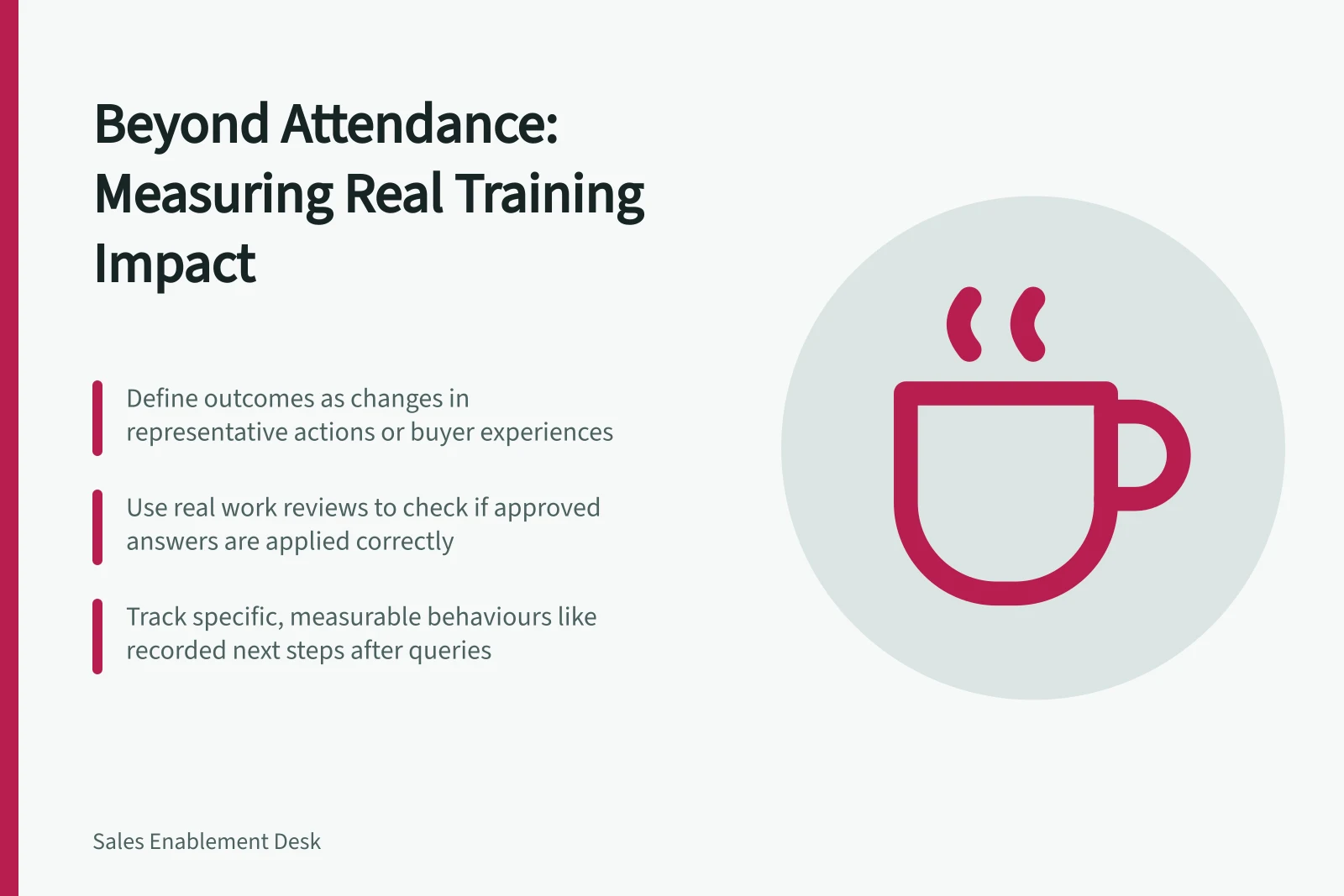
Define the outcome as a change in what representatives can do or do at work, or in what buyers receive from that work. Training attendance shows who took part. It does not show whether someone can use an approved answer, explain its limitations or help a buyer reach an accurate next step.
Start with the change
Write the buyer situation and intended representative action in one sentence. Example: ‘When a buyer asks about implementation, the representative explains the approved steps, identifies any condition that depends on the buyer’s setup and records the next check.’ This objective is proposed for a fictional program.
Then choose evidence for the question you want to answer. A case exercise could show whether a participant can give a sound answer after training. A review of suitable later work could show whether the action occurred in a customer context, where organisational access rules permit it. A buyer follow-up could reveal whether an important question remains unresolved.
| Level to check | Example evidence | Limit |
|---|---|---|
| Delivery | Attendance or module completion | Shows participation, not ability |
| Demonstrated ability | Attempt against a defined case and review criteria | Shows performance in that case, not every live conversation |
| Workplace application | Suitable conversation or account note reviewed against the criteria | Depends on an opportunity and reliable access to the work |
| Buyer response | A verified answer received or next check agreed | Does not alone show that the buyer’s decision advanced |
Define a usable indicator
Before reporting a percentage, specify the population, opportunity and standard. ‘Representatives applied the guidance’ is too vague. A proposed indicator is: ‘Of the reviewed conversations in which a buyer asked an implementation question, how many included the approved explanation, its relevant condition and a recorded next step?’
That wording needs operational rules. Decide who identifies eligible conversations, what counts as a condition, how reviewers handle an incomplete record and whether one conversation may contain several questions. Record the denominator and review period. If few examples qualify, report the cases plainly rather than suggesting a precise trend.
Collect a baseline where feasible and use the same criteria later. If the approved answer or task changes, note that the rounds are not fully comparable. Include exceptions: a representative may correctly escalate instead of answering, and a case with no approved answer should be recorded as an information gap.
Interpret the result
An increase in observed application can support a conclusion about that behaviour in the reviewed work. It does not by itself prove that the program caused a revenue change. Buyer priorities, product changes, manager support and the mix of opportunities can affect broader results. Ask whether the people reviewed had access to the guidance, a suitable chance to use it and feedback on an attempt.
Use the evidence to decide what to change. If people attend but cannot perform the case, improve the explanation or practice. If they perform the case but cannot find the answer at work, fix access.
If they use it accurately and buyers still lack a decision, inspect the approved answer or offer. Keep attendance as a delivery check while judging the program against its intended change.