Enablement Metrics
Measuring enablement programmes
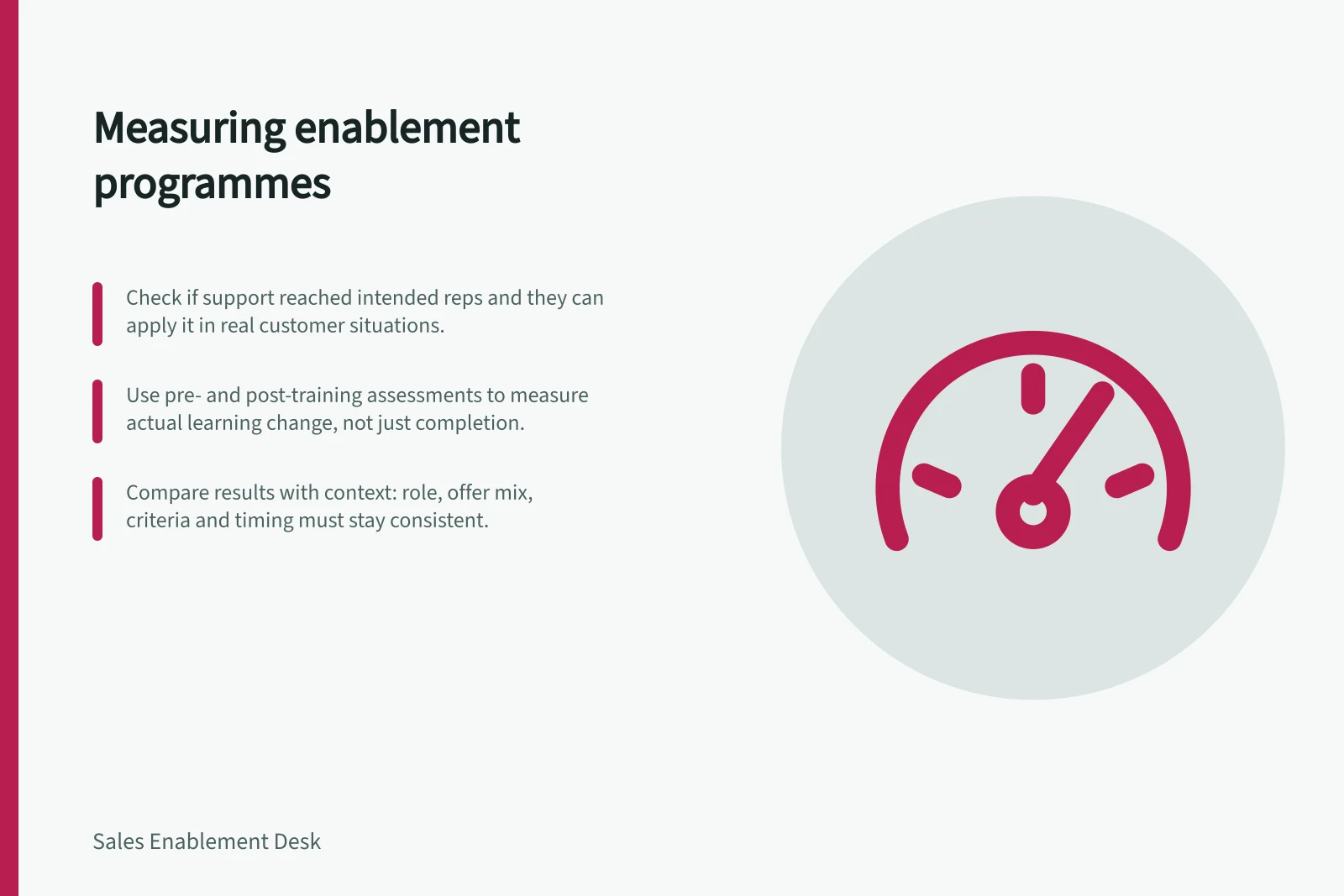
Choose evidence for enablement delivery, readiness, workplace application and buyer response, then use it to make a programme decision.
Measure an enablement programme against the sales task it should improve. Check that the intended people received the support, can perform the task, and can apply it in a suitable customer situation. Then examine what the buyer received. Revenue and conversion are broader outcomes and need separate interpretation.
Start with the decision
Write the review question before choosing metrics. For example: “Should we continue the guidance and practice for explaining implementation responsibilities?” Specify the roles and buyer situations covered, the approved answer, and who will use the finding.
A short measurement brief can record the intended change, eligible work, evidence source, review period, owner and decision date. Agree on these before rollout where possible. Otherwise a convenient activity count may become the measure even when it cannot answer the question.
Key Metrics for Enablement Programme Evaluation
- Support Delivery Rate
- Percentage of reps who accessed guidance or completed practice
- Task Readiness Rate
- Proportion of reps able to perform task in a case review
- Application in Work
- Number of relevant conversations where action was observed
- Buyer Response Quality
- Verified useful response or clear next step in reviewed cases
Match evidence to each step
| Question | Possible evidence | Limit |
|---|---|---|
| Was support delivered? | Access to current guidance, completed practice and manager briefing | Delivery does not show ability. |
| Can representatives perform the task? | Attempts reviewed against an agreed case and criteria | A case does not represent every customer conversation. |
| Was the action applied at work? | Permitted review of suitable conversations or follow-up | Unreviewed work remains unknown. |
| Did the buyer receive a useful response? | A verified answer or a clear next check in the reviewed case | This does not establish a deal outcome. |
For workplace application, report findings with enough context to show which eligible cases were reviewed; detailed conversation-sampling methods are covered separately.
Make comparisons meaningful
Before comparing periods or teams, check whether the task, role, offer, opportunity mix and review criteria remained comparable. Record when guidance or criteria changed.
For ramp time, use the same starting event and bounded readiness standard, and show new starters who have not yet reached it. For conversation application, count only situations where the taught action was relevant and observable.
A practice result and a later workplace observation answer different questions. A representative may complete training but have no suitable opportunity to use it. Another may apply the guidance accurately while a buyer pauses for unrelated reasons. Report those situations as they occurred.
Set the level of assessment to match the question: a test of learning can establish what learners know or can do at that point, while workplace evidence addresses application. Choose the collection method and timing for the information needed and what is practical with the available time and resources.
Interpret sales outcomes cautiously
A change in pipeline, conversion or revenue may prompt investigation. It does not identify which activity made the difference. Check timing, exposure and the intended behaviour, alongside changes in buyer mix, managers, territories and offers. Plan a comparison before rollout when a credible one is feasible, and state its limitations.
Match the conclusion to the evidence: “The action appeared in these reviewed eligible conversations” is narrower than “the programme increased sales”. Missing records or disagreement about the standard weaken even a behavioural comparison.
Pros and Cons of Using Completion Rates as a Metric
- Pros
- Easy to track; shows participation; useful for compliance checks.
- Cons
- Does not prove understanding or application; can inflate progress without impact.
Assess learning change
Set a learning check against the stated learning objectives, rather than relying on a completion record. Assess learning and, where possible, learning transfer; these answer different questions and should remain distinct in the review.
To assess change in knowledge or skill, compare results from an assessment before and after training. A demonstration can test skill as well as knowledge. A post-training assessment alone can show whether learners reached a proficiency level, but cannot show whether they improved; some may have had that knowledge or skill already.
If a pre-training assessment was not feasible, a retrospective pre/post assessment can ask learners to rate their knowledge before and after the course. Treat this as learners’ self-assessment, not as an observed measure of change.
Learning Check vs. Workplace Application: What They Measure
- Learning CheckTests knowledge or skill at a point in time (e.g., quiz after training).
- Workplace ApplicationMeasures actual use of guidance in real customer conversations.
Look for patterns that guide revision
Review combined learner results for trends, not just an overall average. Topics that repeatedly challenge learners may point to a need to improve course content or instruction, while difficulty applying a topic at work may indicate a need for follow-up support.
Review findings with context
Involve the people who deliver and use the support in interpreting findings, consider equity, and use insights throughout the evaluation. Their input can help clarify whether a result reflects the programme, the conditions of the work, or a limitation in the evidence. Record differing interpretations where they affect the decision, rather than presenting an uncertain finding as settled.
Use the review
Decide whether to continue, revise, expand or retire the programme or a particular activity. Consider the buyer need, observed application, maintenance effort and any replacement. Low use alone is not a reason to remove support for an infrequent but consequential question.
Record the decision, its evidence and limits, its owner and the next check.
Revisit the measurement brief when the work or the decision changes. Note what the review changed in the programme and what evidence would help with the next decision.
In this guide
- Comparing ramp time with agreed readiness standardsDefine the start, readiness decision and unfinished cases before comparing sales ramp time across cohorts.
- Measuring training application in customer conversationsReview eligible customer conversations for an observable training action, with clear rules for missing opportunity and incomplete evidence.
- Separating enablement influence from other sales factorsAssess evidence connecting enablement to sales outcomes while checking other changes, comparison groups and causal limits.
- Deciding which enablement activity is not worth maintainingReview an enablement activity's purpose, evidence, maintenance effort and replacement before simplifying or retiring it.