
Sales Coaching
Part of Sales training design
Giving representatives time to apply a newly learned skill
Plan a suitable first use of a new sales skill, protect preparation time and review the attempt without confusing completion with application.
Give a representative a suitable opportunity to use a new skill, time to prepare and a brief chance to review the attempt. “Use this on your next call” is weak planning when the call may not present the right situation or the representative lacks the information needed to act.
Identify a suitable first opportunity
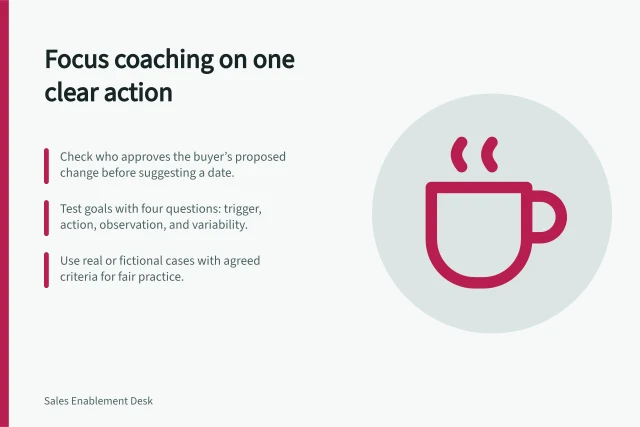
State the skill as an action. A representative may, for example, be learning to confirm a buyer’s approval process before proposing a timetable. A suitable opportunity is a conversation where that process matters and can be discussed. A call about an unrelated support issue would not test the skill.
Agree what the representative needs to prepare: relevant approved information, a question to try and a way to record the answer. Keep preparation proportionate to the task so it fits ordinary work.
If no appropriate customer conversation is scheduled, use a safe scenario for initial practice and revisit workplace use when the situation arises. Record the lack of opportunity rather than treating non-use as failure.
Make room in the work schedule
The manager and representative can identify where an attempt fits among existing commitments. That may mean time before a meeting to prepare or a brief debrief afterwards. The time needed depends on the task; no universal interval suits every skill.
Clarify which parts of the approach are flexible and which require an approved answer. Trying a new question differs from promising an unverified capability. If a buyer asks something beyond the trained scope, the representative needs a route to check it.
Review the attempt
Afterwards, ask what situation arose, what the representative tried, what the buyer said and what remains open. Review a relevant note or recording only where access and organisational rules permit.
Focus on the action the training targeted. A conversation may offer useful practice even if the deal does not progress; a progressing deal does not prove the skill was used.
If the attempt did not happen, identify the obstacle: no suitable conversation, insufficient preparation time, missing information or uncertainty about authority. Each calls for a different response. Repeating a course does not resolve a scheduling or information problem.
Arrange another opportunity when more practice is needed. Keep support close to the work, such as a short question prompt or approved reference. A later check should establish whether the representative had a chance to apply the skill and what support helped, rather than treating training completion as application.
Key Considerations for Skill Application
- Time required for preparation
- Varies by task – no universal standard
- Common obstacles to application
- No suitable conversation, insufficient time, missing info, unclear authority
- Success not tied to deal progress
- Skill use can be effective even if the deal doesn’t close