
Sales Onboarding
Part of Sales training design
Updating training after repeated customer misunderstandings
Diagnose repeated customer misunderstandings, correct the verified explanation and update practice without overlooking conflicting materials.
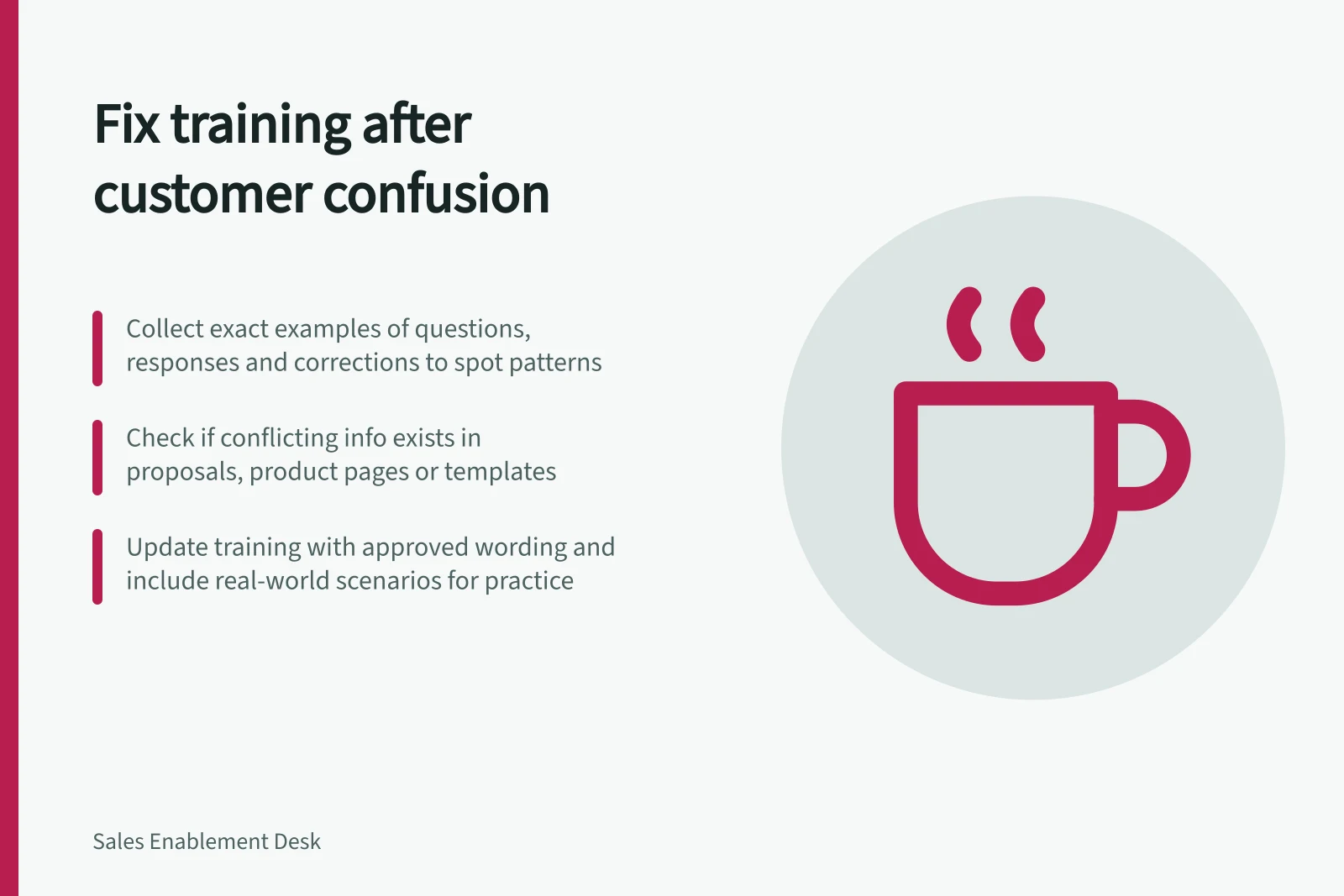
When customers repeatedly misunderstand one point, establish what they were told and what they understood before changing training. The cause may be an inaccurate answer, a missing qualification, unclear wording or information elsewhere in the buyer journey.
Record the misunderstanding precisely
Collect suitable examples of the customer’s question, the representative’s response and the follow-up needed to correct it. Remove personal details unnecessary for the review. Distinguish a request for more detail from evidence that a customer left with the wrong impression.
Group examples by the decision affected. “Customers are confused about implementation” is broad. A more useful description might be: “Buyers understood a proposed setup step to be included in the standard service.” This fictional example is not a finding about a provider.
Check whether the explanation also appears in a presentation, proposal, product page or approved answer. If sources conflict, establish the correct position with the responsible owner before changing training. The verified answer should include any condition that changes it.
Find where meaning changes
Review the sequence without assuming the representative caused the misunderstanding. What did the customer ask? Which phrase or omission could have suggested the wrong conclusion? Was a qualification introduced only after a broad claim, and did the representative have an approved way to answer an exception?
The Australian Competition and Consumer Commission (ACCC) can require businesses to back up claims they make about their products or services.
If the answer remains uncertain, route it to the appropriate product, commercial or legal owner. Do not teach a version of a claim that no one can substantiate.
Change the relevant training
Replace a faulty explanation with approved wording that places the relevant limit beside the claim. Add a case that reproduces the misunderstanding and asks the learner to respond. For example, a fictional buyer asks, “So that setup is included for every customer?”
The learner should check the approved offer, state what is included and explain what still needs confirmation. The actual answer must come from the organisation’s current terms.
Show representatives where to find that answer and when to escalate. If a proposal template or public page contributed to the problem, ask its owner to correct it as well. Training alone cannot resolve contradictory materials.
Where customers may still hold the wrong impression, agree how the organisation will correct it through the appropriate channel.
Before vs After: Correcting Misunderstandings in Sales Training
- Before TrainingBroad claim without qualification: 'Setup is included in standard service.' No guidance on exceptions.
- After TrainingQualified claim: 'Standard setup is included, but complex configurations require confirmation and may incur additional fees.' Learners trained to check terms and escalate when needed.
Check the correction
Ask intended learners to interpret the revised wording before wider use. Use a scenario to see whether they keep the qualification beside the claim and handle a follow-up question. After release, review suitable new examples for the same misunderstanding and for use of the updated guidance.
If the pattern continues, diagnose it again. The answer may remain unclear, the material may be hard to find or the offer may need a different explanation. Record the owner, approved wording and review date so later changes can be reflected in training.