Sales Coaching
Part of Objection handling resources
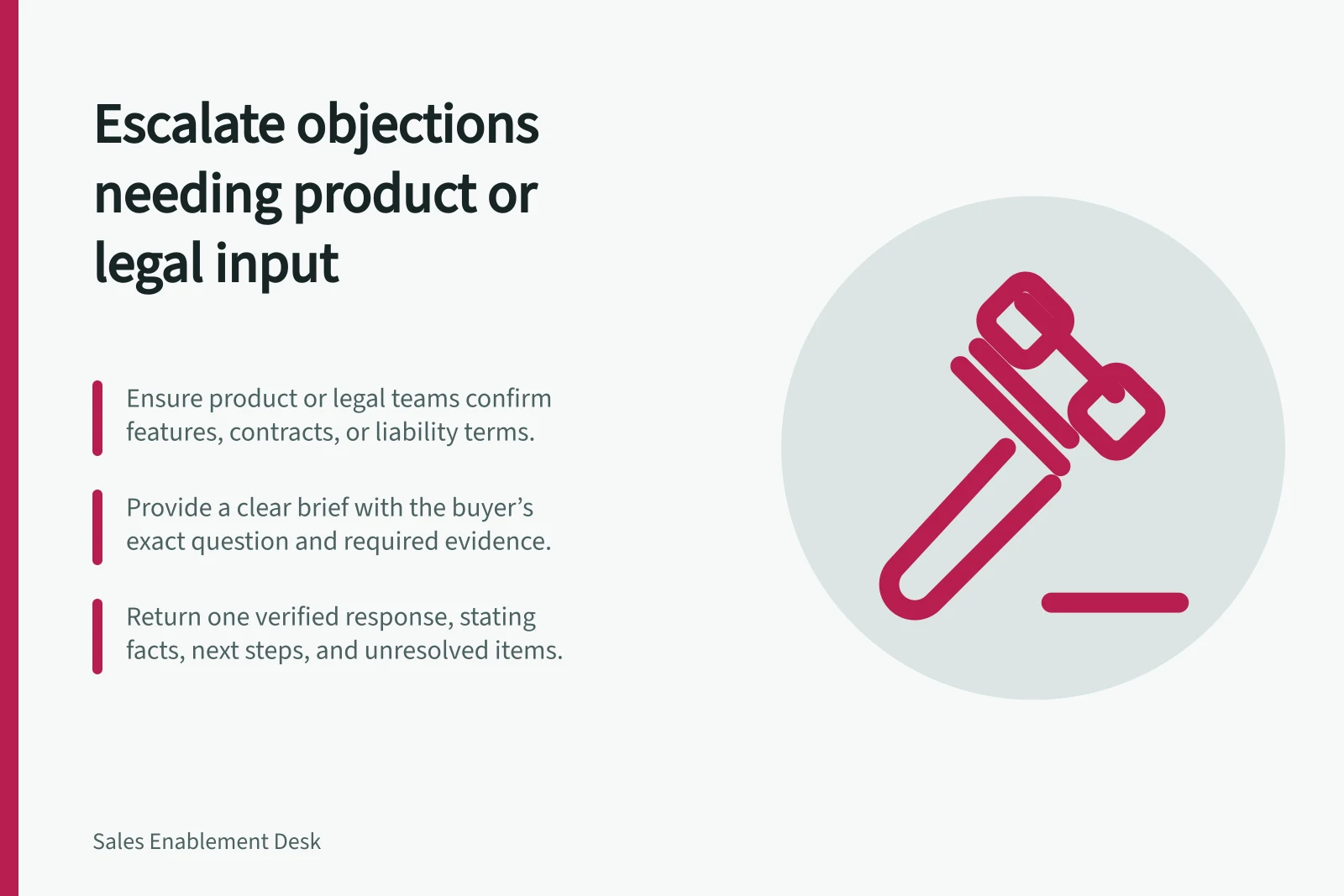
Escalating an objection that needs product or legal input
Route product and contract objections with a clear brief, an accountable owner and a verified response to the buyer.
Escalate an objection when an accurate answer depends on product behaviour, a proposed commitment or contract language the representative is not authorised to confirm.
Define the buyer’s question, avoid an improvised assurance and agree how the answer will be returned.
A product question might concern whether a feature works with the buyer’s configuration. A legal question might ask for different liability wording or a new assurance in an agreement.
The representative can explain an already approved document within its stated scope. They should not interpret an unresolved term or treat a planned feature as available.
Regulatory & Compliance Considerations
- ACCC Guidelines on Misleading Claims
- https://www.accc.gov.au/consumers/advertising-and-promotions/false-or-misleading-claims
- Salesforce Trailhead Module on Objection Handling
- https://trailhead.salesforce.com/content/learn/modules/objection-handling-strategies/learn-how-to-deliver-responses
Make the hand-off answerable
Send the specialist a short brief rather than a forwarded thread with no decision request. Include:
- The buyer’s exact question and the decision it affects.
- Relevant product version, configuration, workflow or proposed contract wording.
- Any answer already given, with its date and recipient.
- The evidence the buyer has requested and the date they need it.
- A named owner who will consolidate the reply and return to the buyer.
If the buyer has asked whether a capability is possible, separate ‘available in the standard product’, ‘possible with configuration’, ‘requires an unassessed change’ and ‘not supported’. These are materially different answers. Ask the product owner which description the evidence supports.
A demonstration in a sample environment may help, but it does not by itself verify the buyer’s own integration or operating conditions.
For contract language, send the exact proposed wording and the commercial context to the organisation’s authorised reviewer. Avoid paraphrasing a legal question so loosely that the reviewer answers a different one. The review may need to establish what the organisation can accept, what needs negotiation and what it will decline. This is an internal routing recommendation, not a substitute for legal advice.
Keep the buyer informed without filling the gap
A useful interim response is specific: ‘I need our product team to confirm that behaviour for your configuration. I will return with the verified answer and any conditions by the agreed date.’ If the date cannot be met, update the buyer rather than allowing silence to stand in for an answer.
When the specialist replies, check that the response addresses the original question and states its limits. Confirm who has approved any customer-facing wording.
Send one coherent response, distinguishing verified facts, proposed next steps and unresolved items. If the answer is ‘we cannot meet that requirement’, state it plainly and discuss only alternatives that have actually been approved.
Close the loop internally. Record the final response in the account context and decide whether it is reusable.
A general product clarification may become a maintained answer record; a negotiated contract position should remain tied to that account unless the authorised owner approves broader use.
The escalation succeeds when the buyer can make the next decision with an accurate answer, even if that decision ends the opportunity.