Sales Playbooks
Objection handling resources
Build objection handling resources that clarify buyer concerns, give verified answers, route specialist questions and remove unsupported promises.
An objection handling resource should help a representative understand a buyer’s concern, provide an answer the organisation can support and flag what still needs checking. It is not a comeback for every possible hesitation. A buyer asking how an integration works needs a different response from one whose required integration is confirmed unavailable.
A useful resource therefore begins with a question: what decision is the buyer trying to make, and what information would change it? The answer may be a concise explanation, a product demonstration, a revised proposal, a specialist response or an honest acknowledgement that the offer does not fit.
Build resources around decisions
Start with concerns representatives actually hear. Keep the buyer’s wording where possible, then describe the underlying decision without claiming to know their motive. ‘This looks expensive’ might refer to the quoted price, implementation effort, budget timing or uncertainty about the outcome. The note should prompt a question before it offers an answer.
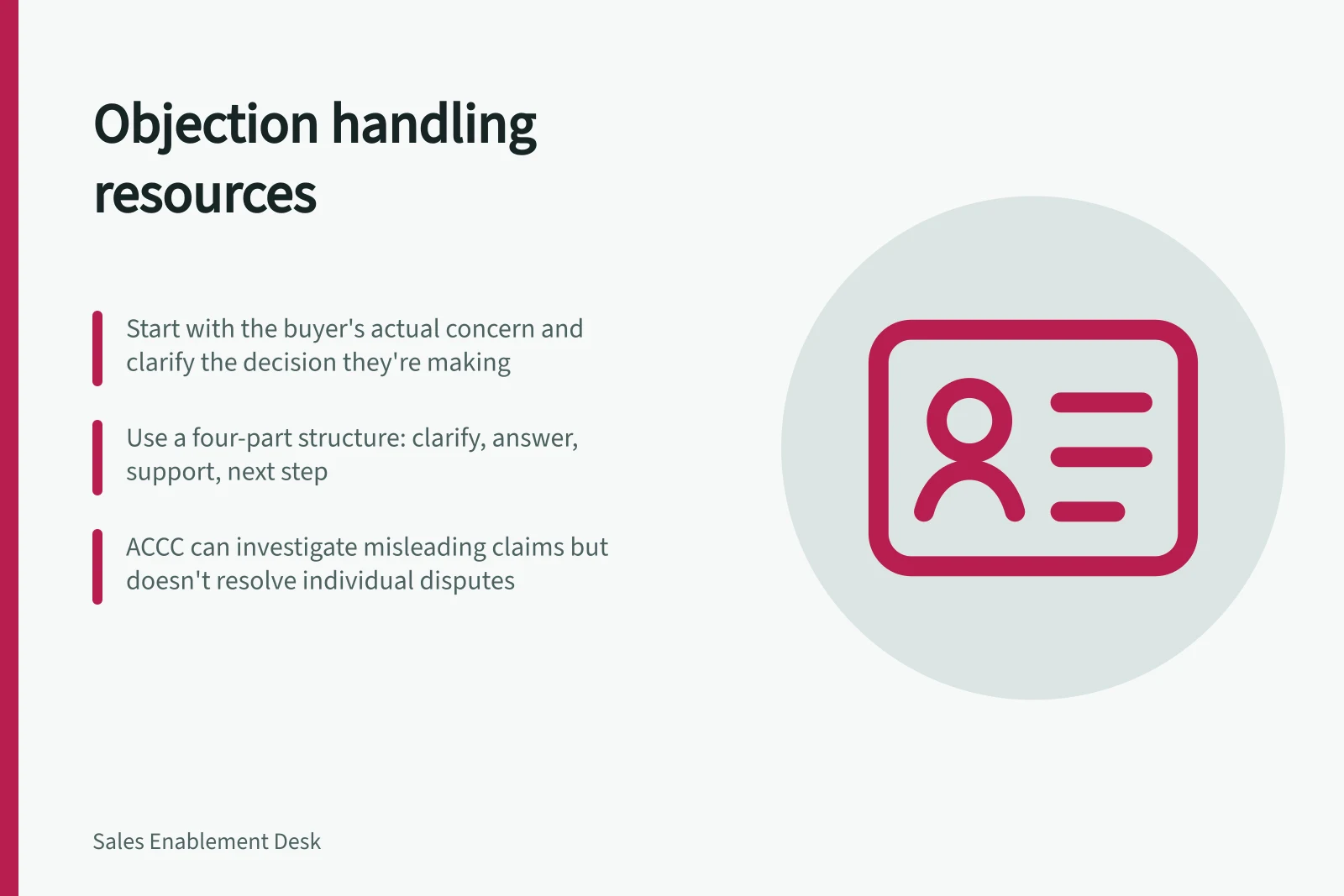
Each resource needs four parts:
- What to clarify:a short question that distinguishes possible meanings.
- What can be said now:an approved answer with its conditions and limits.
- What supports it:a current product document, agreed commercial term or other evidence an owner can verify.
- What happens next:a buyer check, specialist review or explicit fit decision.
This structure lets a representative speak naturally and makes uncertainty visible. If the answer depends on a proposed configuration, customer data or contract wording, the note should say so before anyone treats it as a standard capability.
Match the response to the concern
| What the buyer is establishing | Useful response | When to stop and check |
|---|---|---|
| ‘What does this term mean?’ | Explain the term in the context of their workflow and ask whether it answers the question. | The definition changes across products, plans or agreements. |
| ‘Can your product do this?’ | Describe the currently verified capability and the conditions under which it works. | The answer depends on a feature, integration or configuration that has not been confirmed. |
| ‘Can we meet this deadline?’ | Establish the required date, dependencies and decision owner. | Delivery timing would require an unapproved commitment. |
| ‘We cannot use a provider with this restriction.’ | Confirm the requirement and document the restriction. | No approved exception or workable alternative exists. |
The table is a triage aid, not a way to classify a buyer from one sentence. Confirm the meaning with the buyer. A clear constraint may end the evaluation; that is useful when the offer cannot meet a non-negotiable requirement. The supporting article Distinguishing a genuine constraint from a request for clarification develops this diagnostic step.
Give representatives an answer they can verify
Repeated concerns deserve a maintained answer record, not a series of one-off replies. When the resource is used in a live conversation, separate a general explanation from a promise made for a specific account. Recording accurate answers to repeated buyer concerns covers the record and review process in detail.
A practical note might say: ‘The current product supports the documented export process. Confirm the required fields and volume before saying it meets this buyer’s reporting need.’ That gives a representative something useful to say without turning a product capability into a guarantee about the buyer’s environment.
The ACCC accepts reports about possible misleading or false claims and can require a business to back up claims it makes about its products or services. It does not resolve individual disputes about misleading claims and does not provide legal advice.
Set an escalation route before the meeting
A resource should tell the representative when their authority ends. A product specialist may need to verify a technical behaviour. A commercial owner may need to approve a revised offer. Legal counsel may need to review contract language, rights or a proposed assurance.
The representative can acknowledge the question and agree when the buyer will receive a response, rather than filling the gap with an estimate presented as fact. Escalating an objection that needs product or legal input provides a hand-off format.
Remove promises the organisation cannot support
Review objection notes for absolute terms such as ‘always’, ‘guaranteed’ and ‘fully compatible’. Some may be accurate within a defined scope, but each needs an evidence check.
A safer revision does more than add ‘usually’: it states the actual capability, relevant conditions and an appropriate verification step. If the organisation cannot substantiate the claim, withdraw it rather than softening it into another vague assurance.
Removing unsupported promises from objection-handling notes sets out a focused audit of where such wording appears and how it is corrected.
The resource has done its job when the buyer receives a clear answer or a clear path to one. Track unanswered questions and recurring gaps as well as resolved concerns; they show where product guidance, commercial terms or the offer itself needs attention.
In this guide
- Distinguishing a genuine constraint from a request for clarificationUse neutral questions and observable requirements to tell a genuine buyer constraint from a request for clarification.
- Recording accurate answers to repeated buyer concernsCreate owned answer records with evidence, conditions and review dates so repeated buyer concerns receive accurate responses.
- Escalating an objection that needs product or legal inputRoute product and contract objections with a clear brief, an accountable owner and a verified response to the buyer.
- Removing unsupported promises from objection-handling notesAudit objection-handling notes for unsupported claims, replace them with verified wording and withdraw outdated versions.