Content Libraries
Part of Objection handling resources
Removing unsupported promises from objection-handling notes
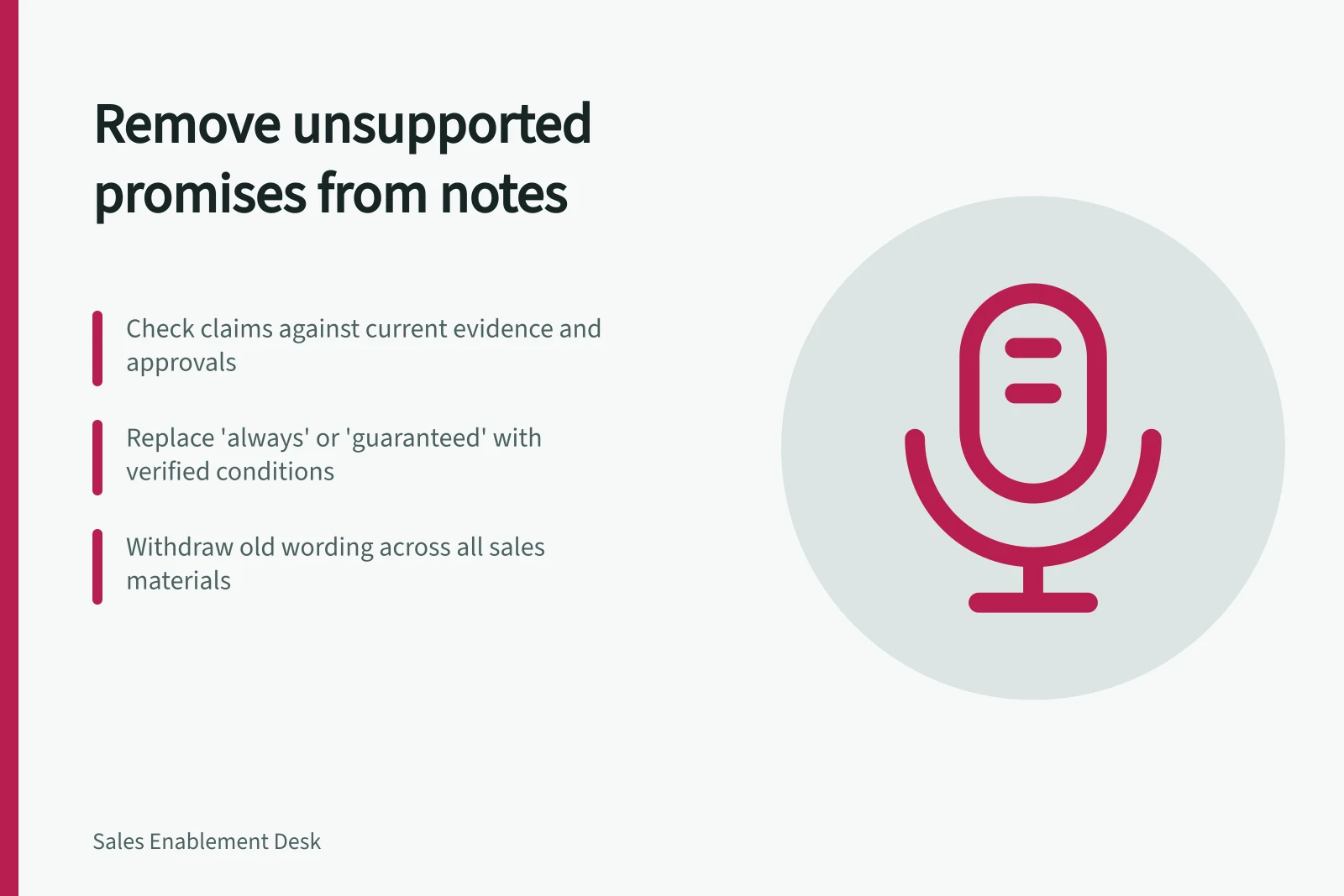
Audit objection-handling notes for unsupported claims, replace them with verified wording and withdraw outdated versions.
Remove a promise from an objection-handling note when the organisation cannot show that it is accurate for the circumstances in which representatives will use it. Replace it with a verified statement and its conditions, or leave the question open for specialist review. A vague qualifier does not repair an unsupported claim.
Start with the notes representatives actually use: response cards, talk tracks, proposal snippets and follow-up templates. Search for absolute or forward-looking wording such as ‘always’, ‘guaranteed’, ‘works with every system’ and ‘will be delivered by’. Those words are review signals, not automatic errors. The issue is whether the evidence and approved commitment match the impression a buyer would take from the full statement.
Check the claim against its evidence
For each flagged line, ask:
- What exactly is being promiseda current capability, a customer outcome, an implementation date or a future feature?
- What evidence supports that promise today?
- Which product, configuration, plan, location or contract conditions affect it?
- Who is authorised to approve the customer-facing wording?
- Does the opening claim remain accurate when its qualifications are read together?
A claim may need narrowing. For example, ‘Integrates with every finance system’ might become ‘The product supports the documented connection methods; we need to assess your finance system and required data flows.’
That example is proposed wording for a fictional product. It is not a claim that any vendor offers those methods. If no connection method is verified, the note should say that assessment is pending.
Avoid replacing ‘guaranteed savings’ with ‘substantial savings’ when no customer-specific basis exists. Describe the mechanism the product can demonstrate and identify what the buyer would have to measure.
Similarly, do not turn a roadmap discussion into a delivery commitment. State what is available now and route any requested future commitment for approval.
Withdraw old wording as well as approving new wording
An edit in the master note will not help if the earlier line remains in a sales deck, copied email or local document. Identify where the promise appeared, replace reusable versions and tell representatives which wording has been withdrawn. Where a buyer may already have received an inaccurate assurance, ask the responsible owner to arrange a clear correction in that account’s context.
Keep an audit record of the original line, the concern, the supporting evidence, the approved replacement and the owner. It should be short enough to maintain and specific enough to explain why the change was made. Review it again when the product, offer or contract terms change.
The ACCC says it can require businesses to back up claims they make about their products or services, and may investigate misleading conduct. Applying that guidance to objection notes is an editorial control, not a claim that every flagged phrase is unlawful. The practical test is whether a representative can use the revised answer without creating a broader impression than the organisation can support.
Key compliance risks from misleading claims in sales notes
- ACCC enforcement power
- Can require businesses to substantiate claims under Australian Consumer Law
- Common red flags in sales scripts
- ‘Always’, ‘guaranteed’, ‘every system’ – these trigger ACCC scrutiny