Content Libraries
Part of Sales content usage analytics
Identifying assets that are shared but misunderstood
Find repeated buyer misinterpretations of widely shared sales assets and decide whether wording, introduction or asset choice needs correction.
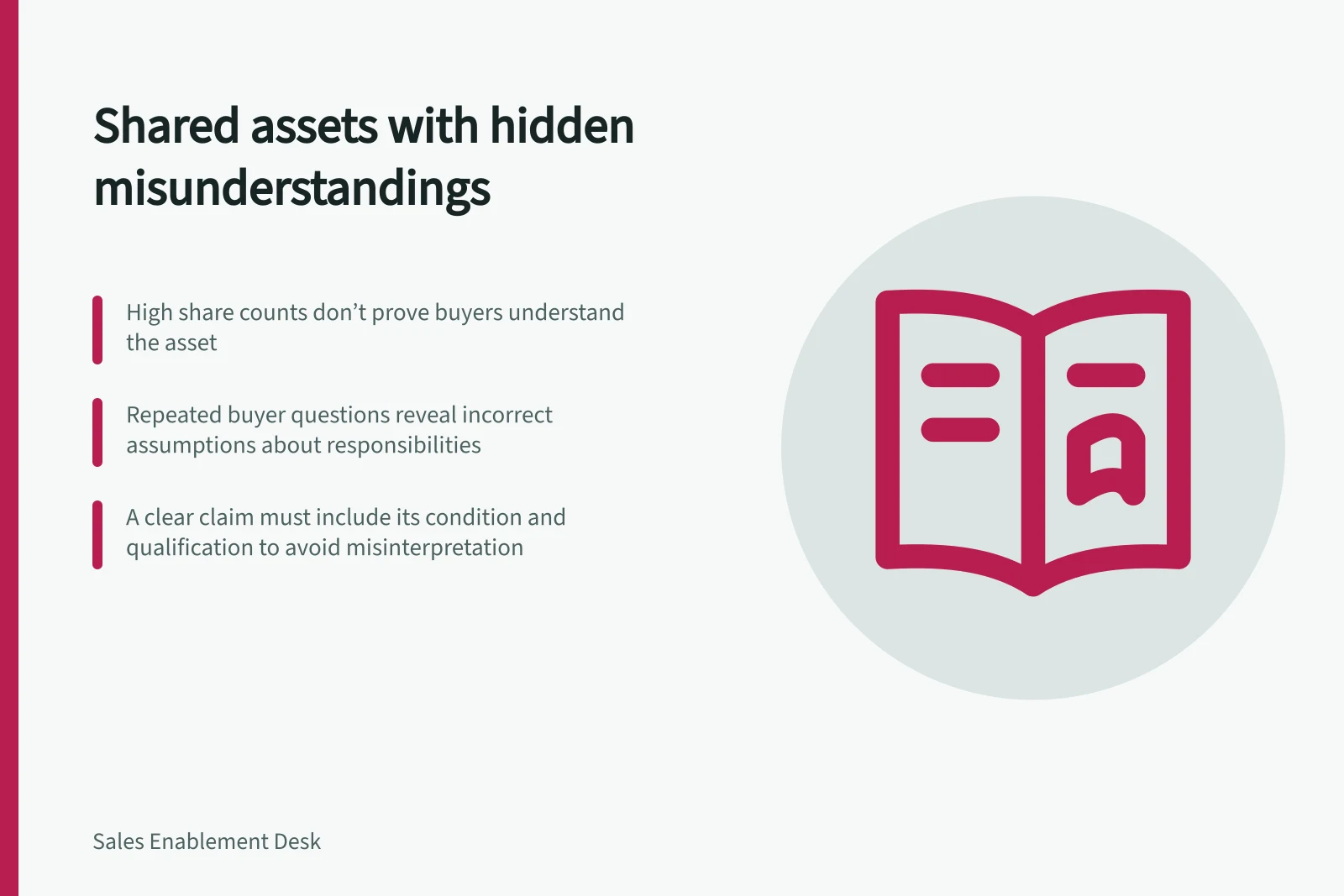
A widely shared asset can still leave buyers with an inaccurate impression. Compare the answer the asset is meant to give with what buyers say, ask or assume afterwards. Share counts help select cases to inspect; they do not diagnose understanding.
Define the intended answer
Choose one approved asset and the buyer question it should answer. Ask its owner to state the main claim, the condition that changes it and the decision a reader should be able to make. Record the version reviewed. “Educate buyers” is too broad to reveal a specific misunderstanding.
For an illustrative implementation overview, the answer might divide a setup task between supplier and buyer. The offer owner would need to confirm the actual responsibilities and exceptions before anyone judged whether the asset expressed them accurately.
Look for a repeated wrong inference
Where access rules permit, inspect relevant buyer follow-up, meeting notes and the version each buyer received. Distinguish a request for more detail from a statement that conflicts with the approved answer. A single question may be ordinary evaluation; a recurring, specific wrong inference gives a stronger reason to investigate.
| Signal | What to check |
|---|---|
| Buyers repeat the same incorrect assumption | Whether the approved version states the answer clearly |
| Representatives add the same verbal correction | Whether the qualification is missing or hard to notice |
| Buyers ask about a condition after receiving a broad claim | Whether the headline creates a wider impression than the detail supports |
| Shares are high but recorded buyer activity is low | Whether viewing occurred through a tracked route |
If you can establish that the file was not opened, distribution or timing may be the issue. A recorded view, where available, still does not show which passage was understood. Treat sharing and access records as prompts for inspection, not evidence of comprehension.
Check the wording against the question
Ask someone unfamiliar with the asset to answer the buyer question using the approved file, including a variation where the material condition applies. Note where they hesitate or reach an answer that conflicts with the approved one. If the answer needs spoken context to remain accurate, consider putting that context in the shareable material.
Where appropriate, ask the buyer what remains unclear. A neutral question such as “What would your team expect to provide at this step?” may expose a wrong assumption, an unanswered requirement or a term used differently in the buyer’s organisation. Check the asset and its introduction before assigning a cause.
Correct the cause
If the asset creates the wrong impression, have its owner revise the claim and place its qualification beside it. If representatives introduce it too broadly, correct the sharing guidance. If it answers a different question, change its description or choose another asset. Withdraw a confusing version where necessary.
Review later suitable cases for the same inference and record the version and buyer question. A change in recorded questions is useful to examine, but missing follow-up or a different buyer mix could also explain it.
Steps to Identify and Correct Asset Misunderstandings
- Revise the claim and place its qualification beside it
- Correct sharing guidance if representatives introduce the asset too broadly
- Change the asset description or choose another asset if it answers a different question
- Withdraw a confusing version where necessary