Enablement Metrics
Part of Measuring enablement programmes
Separating enablement influence from other sales factors
Assess evidence connecting enablement to sales outcomes while checking other changes, comparison groups and causal limits.
To assess enablement’s influence, state the outcome, how the activity could change it and what else changed. Then choose a comparison suited to the claim. A before-and-after revenue chart alone cannot isolate an enablement effect.
Trace the proposed route
Suppose a team introduces guidance and practice for answering implementation questions. The proposed route is that representatives receive the approved answer, can use it in a case, apply it when a relevant question arises and leave buyers with a clear answer or next check. These are links to examine, not observed results.
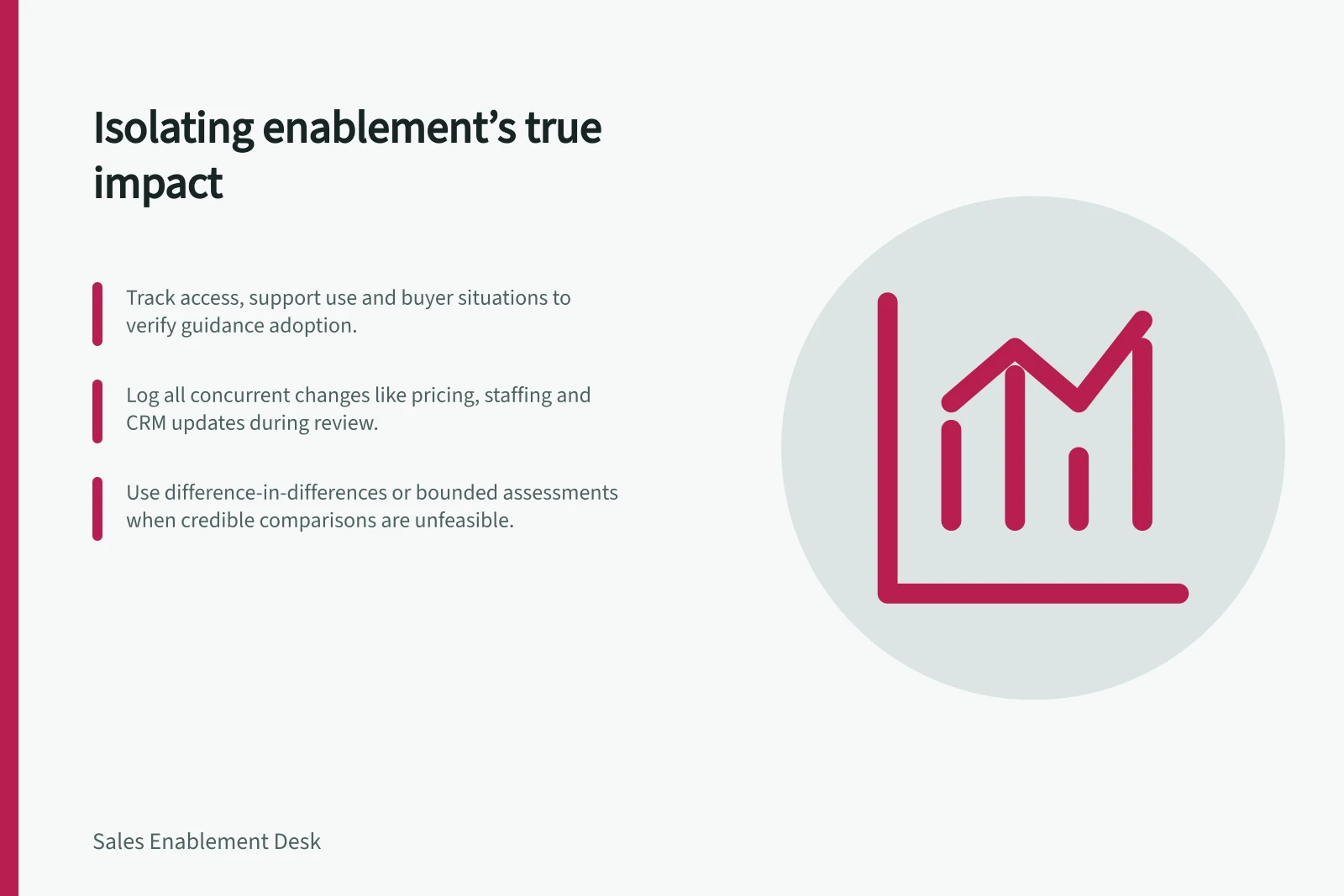
Record when each person gained access, what support they used and whether a suitable buyer situation occurred. An activity launch date does not show who used the support or changed their work.
Review the intended behaviour before interpreting a later sales outcome.
Record competing changes
Keep a dated log of changes during the review period: offers, prices, lead sources, territories, staffing, manager support, seasonality or CRM definitions where relevant. Record what actually changed rather than presenting a list of possibilities as findings. The log helps assess a comparison; it does not by itself adjust the results.
Check whether groups began in similar circumstances, including role, experience, offer and opportunity type. If the programme was assigned first to a team handling unusually difficult deals, a raw comparison with another team says little about its effect.
Choose the claim the design can support
A case review can show whether the intended action appeared in the work examined. Comparable reviews before and after rollout can show whether its observed frequency changed. Neither alone rules out other causes of that change.
A planned comparison group can strengthen an assessment if its conditions and selection are understood. A difference-in-differences analysis makes a further assumption: without the programme, the groups’ outcome trends would have moved similarly. Earlier trends and changes in staffing, markets or offers can inform that judgement, but cannot prove the assumption. Seek evaluation expertise before making a consequential causal estimate from such a design.
Where a credible comparison is impractical, build a bounded contribution assessment. Check whether the support reached the intended people, whether the expected behaviour appeared after exposure, whether buyer-facing evidence fits the proposed route and whether plausible alternatives have been investigated.
State which links remain uncertain. This may inform a decision without yielding a defensible percentage of revenue caused by enablement.
Report the limit of the finding
Separate what changed, the evidence connecting it to the programme and other plausible explanations. “The action appeared more often in these reviewed eligible conversations after rollout” is a behavioural finding if the review supports it. Claiming that it raised conversion requires stronger outcome evidence and design.
A practical decision may still follow from limited evidence. Accurate use of guidance for a recurring buyer question may justify continuing or refining it. If the intended behaviour is absent, inspect access, opportunity and guidance quality before attributing a wider result.