Enablement Metrics
Part of Sales demo enablement
Reviewing whether a demonstration answered the buyer's questions
Review a sales demo against the buyer's questions, not the presenter's slide order.
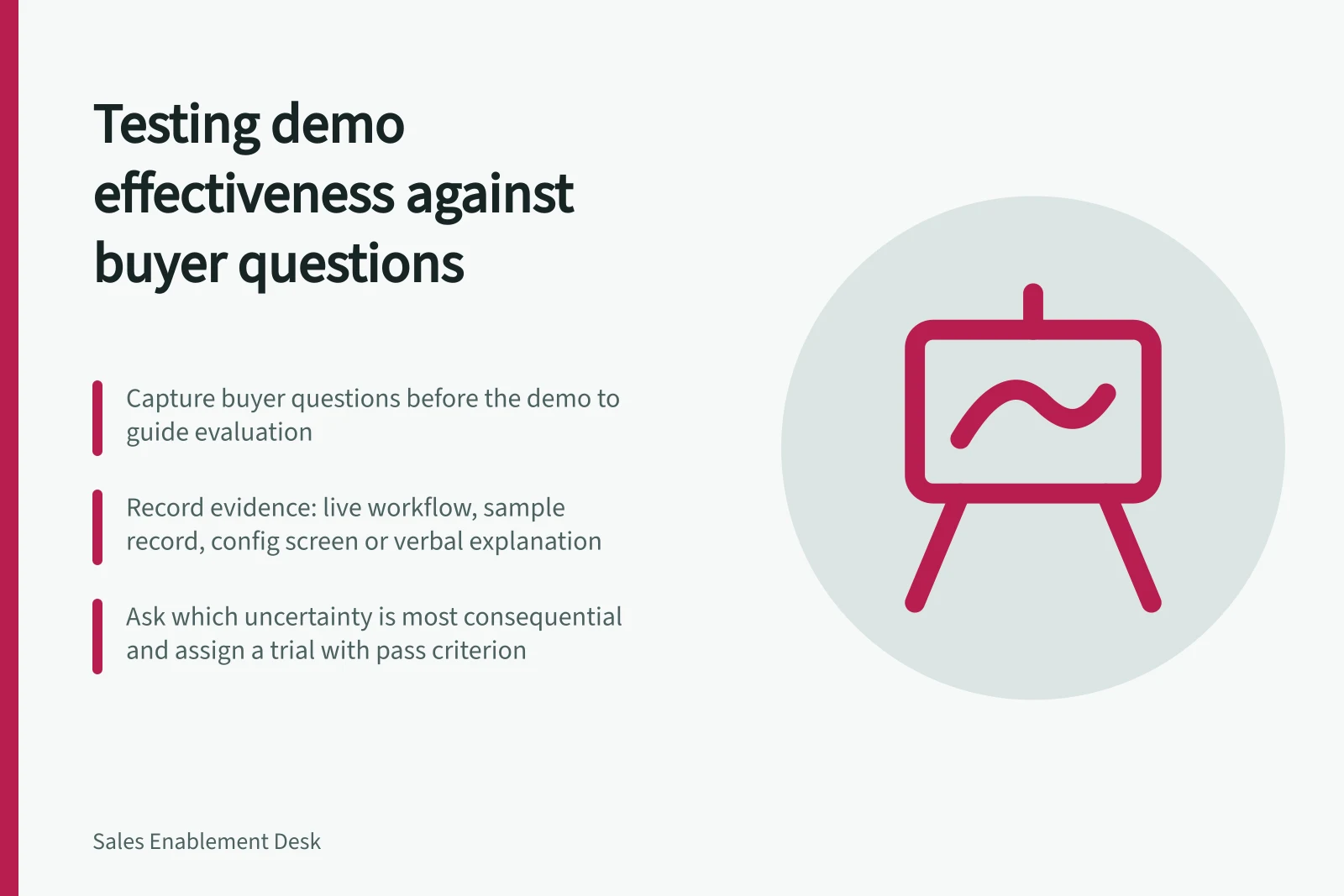
Review a sales demo against the buyer's questions, not the presenter's slide order. Capture those questions before the meeting. Afterwards mark each one as answered with evidence, partly answered, untested or outside scope.
Hold the review soon after the meeting, while the questions and answers are still clear. Ask the presenter and one other attendee to fill in the list separately, then compare. Differences between the two versions can show where a question was answered in the room but never actually shown on screen.
For every “answered” item, record what the buyer saw: a live workflow in a safe environment, a sample record, a configuration screen or a verbal explanation. These are different levels of evidence.
Pay attention to questions the buyer asked more than once. Repetition may mean the first answer did not land, or that it was correct but too general to settle the concern. Mark these items for a more specific response, such as a short recording of one workflow or a written explanation of how an exception is handled.
A demonstration with fictional data can show interface behaviour, but it may not prove that the buyer's integrations, permissions or volumes will work. Keep that distinction clear in the follow-up.
Check the follow-up message against the review. Every item marked partly answered or untested should appear there with a plain statement of what is still open and who will close it. Do not let a confident summary turn an untested capability into something the buyer believes was shown.
Ask the buyer which uncertainty remains most consequential. Route product questions to the right specialist. Turn critical unknowns into a bounded trial with an owner and a pass criterion.
If the demo revealed a mismatch, document it plainly rather than arranging another broad tour.
Store the completed review with the opportunity record. A later reader should see what was shown, what was not and what the buyer still needed to know. Without that link, the next conversation may start again from the slides.
Use the review to improve future preparation: which questions recur, which sample cases are missing and where presenters overstate an untested capability?
Pass these findings to whoever owns demo preparation. A missing sample record, permission setup or specialist is easier to arrange before the next meeting than to explain during it.